
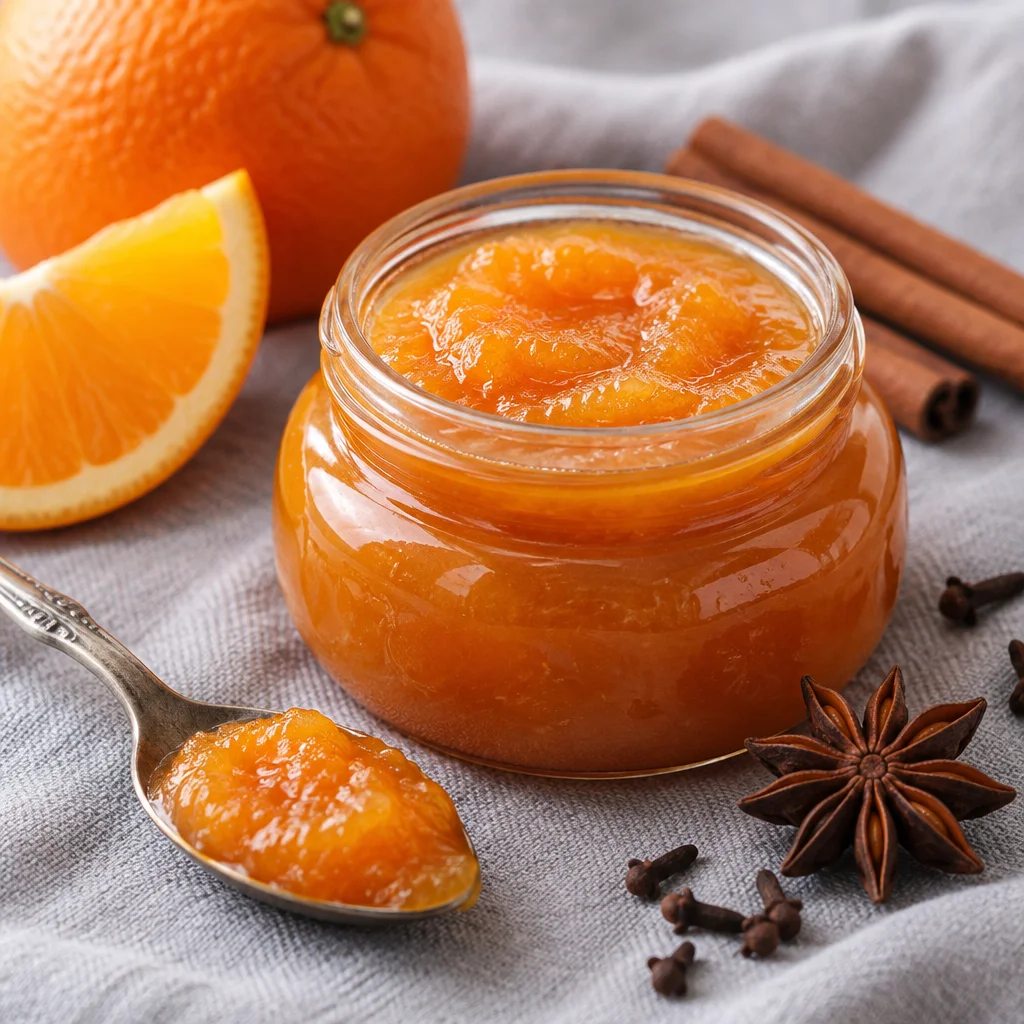
orange jam is one of those things I crave the second the weather turns chilly, but I used to avoid making it because I thought it needed fancy pectin or a candy thermometer. Then I tried a simple batch with just oranges, sugar, lemon juice, and a few warm spices, and I was honestly shocked by how well it set. If you have a bowl of oranges that are getting a little too soft on the counter, this is the perfect save. The house smells like a cozy citrus candle while it cooks, and you end up with a jar that makes plain toast feel special. Let me walk you through exactly how I make Orange Jam with Warm Spices and No Added Pectin, without turning it into a stressful project.
What Makes Orange Jam Different from Orange Marmalade
This comes up a lot because people use the words interchangeably, but they feel different on the spoon. Marmalade usually has lots of peel pieces and that classic bitter edge, while orange jam is smoother, softer, and more straightforwardly sweet citrus. With jam, you can choose how much peel flavor you want, and you can puree it to get that spreadable texture.
If you love pretty citrus projects, you might also like these candied orange slices for topping cakes or dunking in chocolate. Different vibe than jam, but same happy orange energy.
Best Oranges for Homemade Jam
You can make Orange Jam with Warm Spices and No Added Pectin with most oranges, but the final flavor depends a lot on the variety. My personal favorites are navel oranges for everyday batches and Valencia oranges when I want a brighter, juicier flavor.
Here is what I look for at the store:
Good signs are a heavy orange (more juice), thin skin, and a strong citrus smell.
Avoid oranges that are rock hard and dry, or ones with thick pith if you are sensitive to bitterness.
If you want a deeper, almost floral orange note, a couple of mandarins mixed in can be really nice, but keep the main amount as regular oranges so the jam still sets well.
Orange Jam Ingredients and Why the Ratios Matter
This recipe works because the balance is right, not because of any special additive. When people say their jam never sets, it is usually because the fruit to sugar to acid ratio drifted too far.
- Oranges for flavor and natural pectin (especially near the peel and membranes)
- Sugar for sweetness, preservation, and helping the gel form
- Lemon juice to boost acidity so the jam sets and tastes bright
- Warm spices like cinnamon, clove, or cardamom (optional but so good)
- Salt just a pinch, it makes citrus taste more like itself
I keep it simple: for every 4 cups of prepared orange puree, I usually use about 3 cups of sugar, plus a few tablespoons of lemon juice. If your oranges are very sweet, do not cut the sugar too much. It is not just sweetener, it is structure.
How Lemon Juice and Sugar Help the Jam Set
Here is the no-scary science version. Oranges have some natural pectin, but pectin needs the right environment to thicken. Sugar helps pectin link up, and acid (that is the lemon juice) helps those links form properly. If you skip the lemon, you may end up simmering forever and still get syrup.
Also, a small tip from my own mistakes: add lemon juice early so it cooks in and the flavor mellows. If you add it at the very end, it can taste sharp and separate from the orange flavor.
Optional Warm Spices for Winter Orange Jam
This is the part that makes my kitchen smell like the holidays. Warm spices are totally optional, but once you try them, it is hard to go back. For Orange Jam with Warm Spices and No Added Pectin, I usually pick one main spice and one supporting spice so it stays orange-forward.
My favorite combos:
Cinnamon plus a tiny pinch of clove is cozy and classic.
Cardamom plus vanilla tastes fancy but still simple.
Ginger plus cinnamon is bright and slightly spicy, great with yogurt.
If you enjoy spiced preserves, you might also want to peek at this rhubarb cinnamon jam. Different fruit, same comfort-food mood.
Equipment for Cooking and Canning Orange Jam
You do not need a professional setup, but a couple tools make life easier.
Nice to have:
Wide heavy pot or Dutch oven, wooden spoon or silicone spatula, ladle, clean jars with lids, and a funnel.
If you are canning: a canning pot or deep stockpot, jar lifter tongs, and a rack (or even a folded towel in the bottom if you are careful and the jars do not rattle).
And do yourself a favor and chill a couple small plates in the freezer now. You will use them later for the gel test.
How to Prepare and Puree the Oranges
This is where you control bitterness and texture, so do not rush it.
What I do:
1) Wash and scrub the oranges really well. Even if you are not using much peel, you will be handling it a lot.
2) Zest a couple of the oranges if you want a stronger orange pop. Keep it light. Avoid the white pith.
3) Peel the oranges. I remove most of the thick white pith because that is where bitterness can sneak in.
4) Slice and remove seeds. Seeds can add bitterness too, and nobody wants to bite one.
5) Puree the fruit. I like a slightly textured puree, not baby food smooth. A blender works, but I usually use an immersion blender right in the pot later.
If you want a holiday-style spread for gifts, this Christmas jam recipe is also a fun one to put next to orange jam in a little gift basket.
How to Cook Orange Jam Without Added Pectin
This is the heart of Orange Jam with Warm Spices and No Added Pectin, and it is mostly about patience. Jam sets from cooking down and concentrating, not from rushing with high heat.
My simple cooking timeline
Start by combining orange puree, sugar, lemon juice, zest (if using), pinch of salt, and your spices in a wide pot. Bring it up to a gentle boil, then lower to a steady simmer where it bubbles consistently but does not spit lava all over your stove.
Stir often, especially once it thickens. As it reduces, it can scorch near the bottom, and burnt orange is not a cute flavor. After about 25 to 45 minutes (depending on your pot and water content), it should look glossy and thicker, and the bubbles will get slower and heavier.
Tip I learned the hard way: If you cook on super high heat to speed it up, the jam can taste a little flat and overly caramelized. Gentle simmer tastes fresher.
How to Test Orange Jam for Gel Stage
You have a couple easy options here, and you do not need special gadgets.
The frozen plate test
Take one of those chilled plates from the freezer, drop a little jam on it, and wait 30 seconds. Drag your finger through the jam. If it wrinkles a bit and the line stays, you are very close or done. If it runs back together like syrup, keep cooking and test again in 5 minutes.
The spoon test
Lift a spoonful of jam and let it drip. When it starts falling off in thicker sheets instead of thin drips, it is getting there.
Remember that orange jam thickens more as it cools, especially overnight. I stop cooking when it looks slightly looser than I want in the jar.
How to Fix Jam That Is Too Runny or Too Thick
It happens, even if you did everything right. Fruit varies.
If it is too runny
Put it back in the pot and simmer again for 5 to 10 minutes, then retest. If you already jarred it, you can pour it back out and re-cook, or just call it orange syrup and drizzle it over pancakes. I have done both, no shame.
If it is too thick
Stir in a little hot water or warm orange juice, just a tablespoon at a time, until it loosens. Do it gently over low heat so it blends smoothly.
How to Prevent Bitter Orange Jam
Bitterness is the main reason people say they do not like orange spreads, but it is usually fixable.
My go-to bitterness blockers:
Remove most of the pith if your oranges have a thick white layer.
Skip a lot of peel unless you know you love that marmalade style bite.
Remove seeds and any tough membranes if you notice many.
Do not overcook to the point of a dark, sticky caramel. That can read bitter too.
How to Water Bath Can Orange Jam Safely
If you want pantry-stable jars, water bath canning is the way to go. This method is meant for high-acid foods like this orange jam, especially with added lemon juice.
Basic steps:
Use clean, hot jars. Fill with hot jam, wipe rims clean, apply lids, then process in boiling water according to safe canning timing for jams in your area. Jars should be covered by at least an inch of water while processing.
If canning feels intimidating, start by making a smaller batch and storing it in the fridge. Then try canning later when you feel ready.
Altitude Adjustments, Headspace, and Jar Sealing
Altitude matters because water boils at a lower temperature as you go higher, so processing times may need to increase. If you live at a higher elevation, check a trusted canning resource for the correct time adjustment.
Headspace is just the empty space at the top of the jar. For jam, I aim for about 1/4 inch. Too much headspace can mess with sealing. Too little can force jam under the lid.
After processing, let jars sit undisturbed. You should hear that satisfying pop as they seal. If a jar does not seal, just refrigerate it and eat it first. It is still totally good.
Storage, Freezing, and Shelf-Life Options
For Orange Jam with Warm Spices and No Added Pectin, you have a few storage choices, depending on how much you made and how quickly you will eat it.
Fridge: If you do not can it, store it in the refrigerator and use within a few weeks.
Freezer: Jam freezes surprisingly well. Leave a little extra space in the container for expansion. Thaw overnight in the fridge.
Pantry: Properly water-bath canned jars can be stored in a cool, dark place for about a year for best quality. Once opened, keep in the fridge.
Ways to Use Orange Jam plus Common FAQs
I use orange jam in more ways than I expected when I first started making it. It is not just for toast.
Easy ideas:
Swirl into plain yogurt with granola, spread on a warm biscuit, spoon over oatmeal, or brush onto roast chicken in the last few minutes for a sticky glaze.
Also, it is amazing with chocolate. If you are into that combo, these orange chocolate truffles are dangerously easy and make a cute gift.
Common questions
Q: Can I reduce the sugar?
A: You can a little, but do not cut it drastically or the jam may not set well and it will not last as long. If you want less sweet, try serving a thinner layer and pairing it with something tangy like Greek yogurt.
Q: Do I have to add warm spices?
A: Nope. The base recipe is great on its own. Spices just give it that winter vibe.
Q: How do I know when it is done if I do not have a thermometer?
A: Use the frozen plate test. It is simple and reliable once you do it once or twice.
Q: Why did my jam turn dark?
A: It likely cooked too hot or too long, or the pot was too narrow so it took longer to reduce. Next time, use a wider pot and a steadier simmer.
Q: Can I leave out the lemon juice?
A: I would not. Lemon juice helps the jam set and keeps the flavor bright. It is a key part of making no-pectin jam work.
My last little nudge to try it
If you have been on the fence, make a small batch of Orange Jam with Warm Spices and No Added Pectin and see how satisfying it is to watch it thicken on its own. Once you get the hang of the gel test, it stops feeling mysterious and starts feeling relaxing. For more no-pectin inspiration, I have linked the Orange Jam Recipe – Recipe52.com because it is another helpful reference, and I also love reading cultural variations like Orange Jam – Palestine In A Dish for different approaches and flavor ideas. Grab some oranges, put on something cozy in the background, and give it a go. You are going to be so happy you did.
Print
Orange Jam with Warm Spices
- Total Time: 1 hour 15 minutes
- Yield: 4 jars 1x
Description
A delightful and simple orange jam recipe that captures the cozy essence of citrus with warm spices, perfect for enhancing your favorite toast or yogurt.
Ingredients
Main Ingredients
- 4 cups oranges, prepared and pureed (Navel or Valencia oranges are recommended.)
- 3 cups sugar (Do not reduce sugar drastically as it helps jam set.)
- 2 tablespoons lemon juice (Add early to allow flavor to mellow.)
- 1 pinch salt (Enhances citrus flavor.)
- 1 teaspoon warm spices (cinnamon, clove, cardamom, ginger) (Choose one main spice and one supporting spice.)
Instructions
Preparation
- Wash and scrub the oranges thoroughly.
- Zest a couple of oranges if desired, avoiding the white pith.
- Peel the oranges and remove most of the thick white pith.
- Slice and remove seeds from the oranges.
- Puree the fruit to a slightly textured consistency.
Cooking the Jam
- In a wide pot, combine orange puree, sugar, lemon juice, zest if using, a pinch of salt, and chosen spices.
- Bring the mixture to a gentle boil and then reduce to a steady simmer.
- Stir often to prevent scorching, cooking for about 25 to 45 minutes until thickened.
Testing and Canning
- To test for gel stage, use the frozen plate test or the spoon test.
- If too runny, simmer for 5 to 10 more minutes; if too thick, stir in hot water until desired consistency is reached.
- For canning, fill clean, hot jars with hot jam, wipe rims, apply lids, and process in boiling water.
Notes
Store in the refrigerator for a few weeks or freeze for longer storage. Water-bath can for pantry stability. Make sure to adjust processing times if at high altitude.
- Prep Time: 30 minutes
- Cook Time: 45 minutes
- Category: Breakfast, Preserve
- Cuisine: American
Nutrition
- Calories: 240
- Sugar: 57
- Sodium: 5
- Fat: 0.2
- Carbohydrates: 61
- Fiber: 1
- Protein: 0.5









 Appetizers & Sides
 Main Dishes
 Drinks & Wellness
 Desserts & Baking